

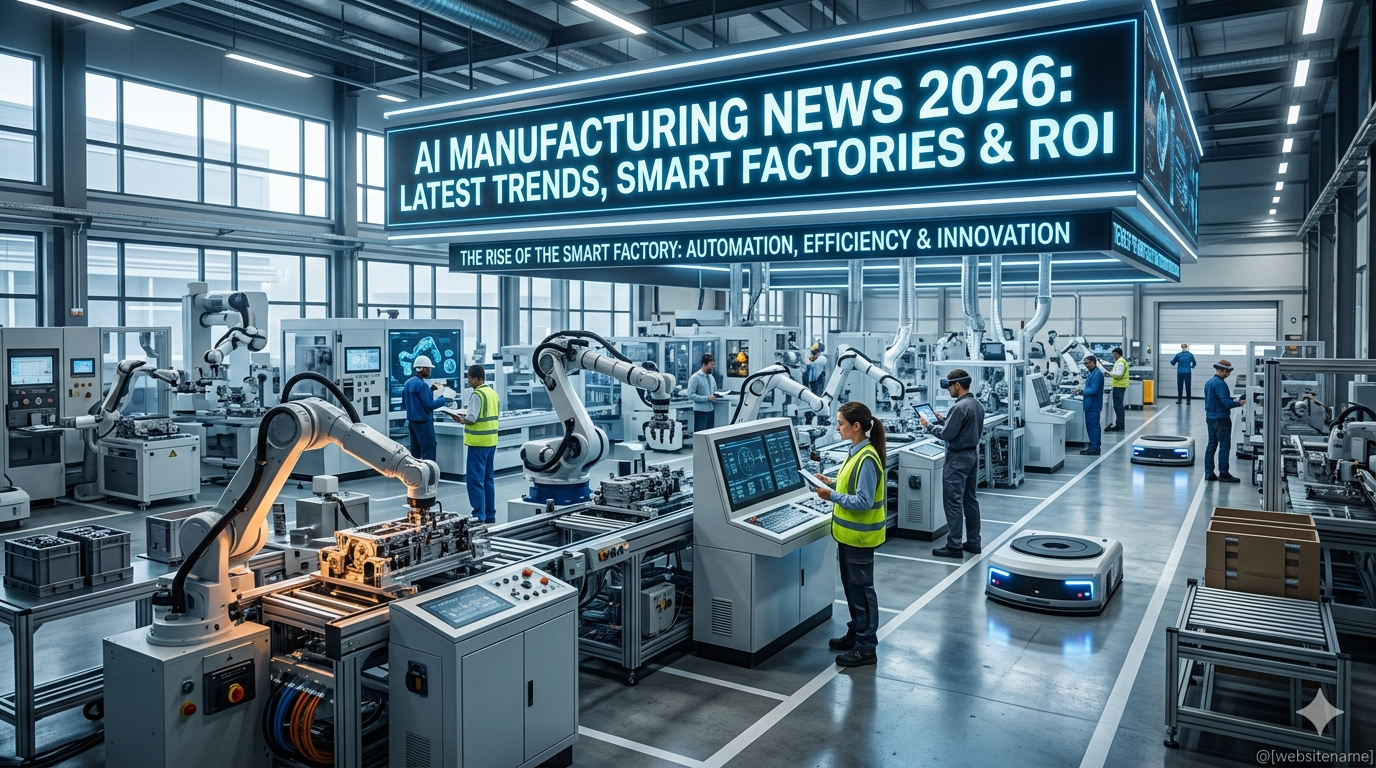
Hello there! If you have been following the news lately, you know that the world of making things is changing fast. It feels like every day there is a new ai manufacturing news story about a robot doing something amazing or a computer predicting a problem before it even happens. In 2026, we are no longer just “testing” artificial intelligence. We are living in the age of the smart factory. It is a very exciting time to see how these high-tech tools help people build products faster, safer, and with much less waste.
I remember just a few years ago when people thought AI was only for science fiction movies. Now, it is the backbone of the assembly line. Big companies and small shops alike are using these tools to stay competitive. In this post, we will dive deep into the most recent updates and see why everyone is talking about the future of production. We will look at real examples, check out some cool statistics, and explain it all in a way that is super easy to understand. Let’s get started on this journey into the heart of modern industry!
The Rise of Agentic AI in Production Lines
The biggest ai manufacturing news this year is the move toward “Agentic AI.” Unlike older systems that just sent an alert when something broke, these new AI agents can actually make decisions. If a machine in a factory sees that it is running out of parts, it doesn’t just beep. It talks to the warehouse, orders more parts, and tells the delivery robot where to go. This happens in seconds without a human needing to click a single button.
These agents are like having a super-smart manager who never sleeps. They look at the “big picture” of the factory floor every second. This helps keep everything moving smoothly. For example, if one part of the line gets stuck, the AI can automatically slow down other parts so that things don’t pile up and cause a mess. It is all about being proactive instead of just reacting to problems after they happen.
Digital Twins: The Virtual Factory Floor
Another huge trend in ai manufacturing news is the use of “Digital Twins.” Imagine having a perfect video game version of your entire factory on a computer screen. This virtual model is connected to real-world sensors. When a real machine moves, the virtual one moves too. Engineers use these twins to test new ideas without ever stopping the real machines. It is like practicing a sports play in a simulator before doing it on the field.
In 2026, these twins are becoming very advanced. Companies like PepsiCo are using them to find up to 90% of potential problems before they even start building a new line. This saves a huge amount of money and time. It also means that when a factory decides to make a new product, they can “flip a switch” much faster because they already know exactly how the machines will behave.
Predictive Maintenance Saves Billions
One of the most helpful parts of ai manufacturing news involves “Predictive Maintenance.” In the old days, machines were fixed only when they broke or on a set schedule. Now, AI looks at vibrations, heat, and sound to “feel” when a part is about to wear out. It is like your car telling you exactly which bolt is going to loosen up three weeks from now.
This technology is a total game-changer for big companies. When a machine breaks unexpectedly, it can cost thousands of dollars every minute it is down. By fixing things during planned breaks, factories keep their “up-time” very high. Experts say this is one of the best ways to improve a company’s bottom line. It makes the whole process more reliable for the workers and the customers.
Human-Machine Collaboration (Cobots)
A common worry in ai manufacturing news is that robots will take all the jobs. However, in 2026, we see a different trend called “Human-Machine Collaboration.” We use “Cobots,” which are collaborative robots designed to work right next to people. The robot does the heavy lifting or the boring, repetitive tasks, while the human worker focuses on the tricky parts that require a “human touch” and creativity.
This makes the workplace much safer. Robots can handle dangerous chemicals or very hot parts, keeping people out of harm’s way. It also makes jobs more interesting. Instead of just moving a box all day, a worker might spend their time teaching the robot how to do a new task. It is a partnership where both the human and the machine bring their best skills to the table.
Smart Supply Chains and Demand Forecasting
The world has learned a lot about supply chains lately, and ai manufacturing news shows that AI is the hero here too. AI can look at the weather, global news, and even social media trends to guess what people will want to buy. If a certain toy becomes popular on video apps, the AI tells the factory to start making more of them before the store even runs out.
This is called “Demand Forecasting.” It helps prevent “stockouts” (when you can’t find what you want) and also prevents “overstock” (when too much stuff is made and wasted). By being smarter about what we make, we save energy and resources. It is a win for the company and a win for the planet.
Sustainable and “Green” Manufacturing
Speaking of the planet, ai manufacturing news is full of stories about “Green Manufacturing.” AI is excellent at finding ways to use less electricity. It can dim the lights in areas where no one is working or adjust the cooling systems to be more efficient. Even small changes, when multiplied across a giant factory, make a massive difference in carbon footprints.
Many factories are now using AI to track their “Digital Product Passports.” This keeps a record of every material used in a product. When the product is old and finished, the AI helps figure out the best way to recycle each part. This “circular economy” is becoming a big goal for many countries in 2026 to help protect our environment.
AI in Quality Control: Zero Defects
Have you ever bought something that was broken right out of the box? ai manufacturing news suggests that those days are almost over. New AI cameras can look at thousands of parts per minute. They can see tiny scratches or cracks that a human eye might miss. If a part isn’t perfect, the AI flags it immediately and removes it from the line.
This “Real-Time Quality Inspection” ensures that only the best products reach the customers. It also helps the factory figure out why a mistake happened. If the AI notices that many parts are coming out slightly crooked, it can trace the problem back to a specific machine and suggest a fix. This keeps the quality high and the customers happy.
Generative Design: Better Products, Less Material
One of the coolest parts of ai manufacturing news is “Generative Design.” Engineers give the AI a goal, like “Make a chair that is very strong but very light.” The AI then looks at thousands of different shapes and materials to find the perfect design. Often, the AI comes up with strange, organic shapes that look like they grew in nature rather than being made in a factory.
These designs often use much less material than traditional shapes. This makes the products cheaper to ship and better for the environment. NASA is even using this to design parts for moon missions! When AI and human engineers work together, they can create things that neither could have made alone.
The Importance of Data Security (Cybersecurity)
As factories get smarter, they also need to get tougher against hackers. A big part of ai manufacturing news involves cybersecurity. Since all the machines are connected to the internet, they need “digital shields” to stay safe. AI is actually used to protect itself! It watches for any strange behavior in the factory network and blocks suspicious activity instantly.
This is very important for keeping our infrastructure safe. If a factory making medicine or car parts gets hacked, it could be a big problem. That is why companies are investing heavily in “Secure AI.” They want to make sure that their smart factories stay smart and safe from any outside interference.
The Global Race for AI Leadership
Finally, ai manufacturing news shows a massive global race. While the United States and China are big players, countries like the UAE and South Korea are leading the way in how many people actually use AI. In 2026, being “good at manufacturing” means being “good at AI.” Every country wants to have the smartest factories to grow their economy.
This competition is actually good for us because it leads to more innovation. We get better products, more efficient services, and new technologies every day. As we move forward, the “AI gap” between different parts of the world is something experts are watching closely. The goal is to make sure everyone can benefit from these amazing new tools.
Conclusion
In summary, the ai manufacturing news of 2026 is all about growth, safety, and efficiency. We have seen how agents make decisions, how digital twins prevent mistakes, and how humans and robots are becoming the ultimate team. The factory of the future isn’t a cold, dark place full of machines—it is a bright, high-tech hub where creativity and data come together to solve big problems.
Whether you are a student, a business owner, or just someone who likes tech, it is a great time to pay attention. These changes will affect everything we buy and how we work. What do you think is the most exciting part of the AI revolution in factories? Let us know your thoughts!
FAQs
1. Will AI take away all the factory jobs? No, the latest ai manufacturing news shows that AI is changing jobs rather than just removing them. While some repetitive tasks are done by robots, new jobs are being created in AI management, robot maintenance, and data analysis.
2. What is a “Digital Twin” in simple terms? A digital twin is like a “live” map or a video game version of a real factory. It uses sensors to show exactly what is happening in the real world on a computer screen so engineers can test changes safely.
3. Is AI in manufacturing expensive to start? While the initial setup can cost money, the news shows that AI often pays for itself quickly. By reducing waste and preventing machine breakdowns, companies actually save more money in the long run.
4. How does AI help the environment in factories? AI helps by finding ways to use less energy and fewer materials. It also helps with recycling by tracking what every product is made of, leading to a much “greener” way of making things.
5. Can small businesses use AI in manufacturing too? Yes! While big companies were the first to use it, AI tools are becoming much cheaper and easier to use. Small shops are now using AI for simple things like scheduling and quality checks.
6. What is “Predictive Maintenance”? This is when AI uses sensors to “listen” to machines and guess when they might break. This allows the factory to fix the machine before it stops working, saving time and money.
References & Sources:
- Microsoft Global AI Diffusion Report (May 2026)
- NVIDIA & Corning AI Infrastructure Partnership Announcement (May 2026)
- Protolabs Innovation in Manufacturing Guide (April 2026)
- Adastra AI Use Cases in Manufacturing Strategy (2026)
Leave a Reply